Key takeaways
- Cold floors are caused by cold air entering below the floor and by heat escaping into unheated spaces.
- The basement rim joist is the most common source of cold air.
- Floors over garages, crawl spaces and porches need insulation and air sealing underneath.
- Sealing the attic also helps, because it reduces the stack effect that pulls cold air in at the bottom.
Why floors get cold
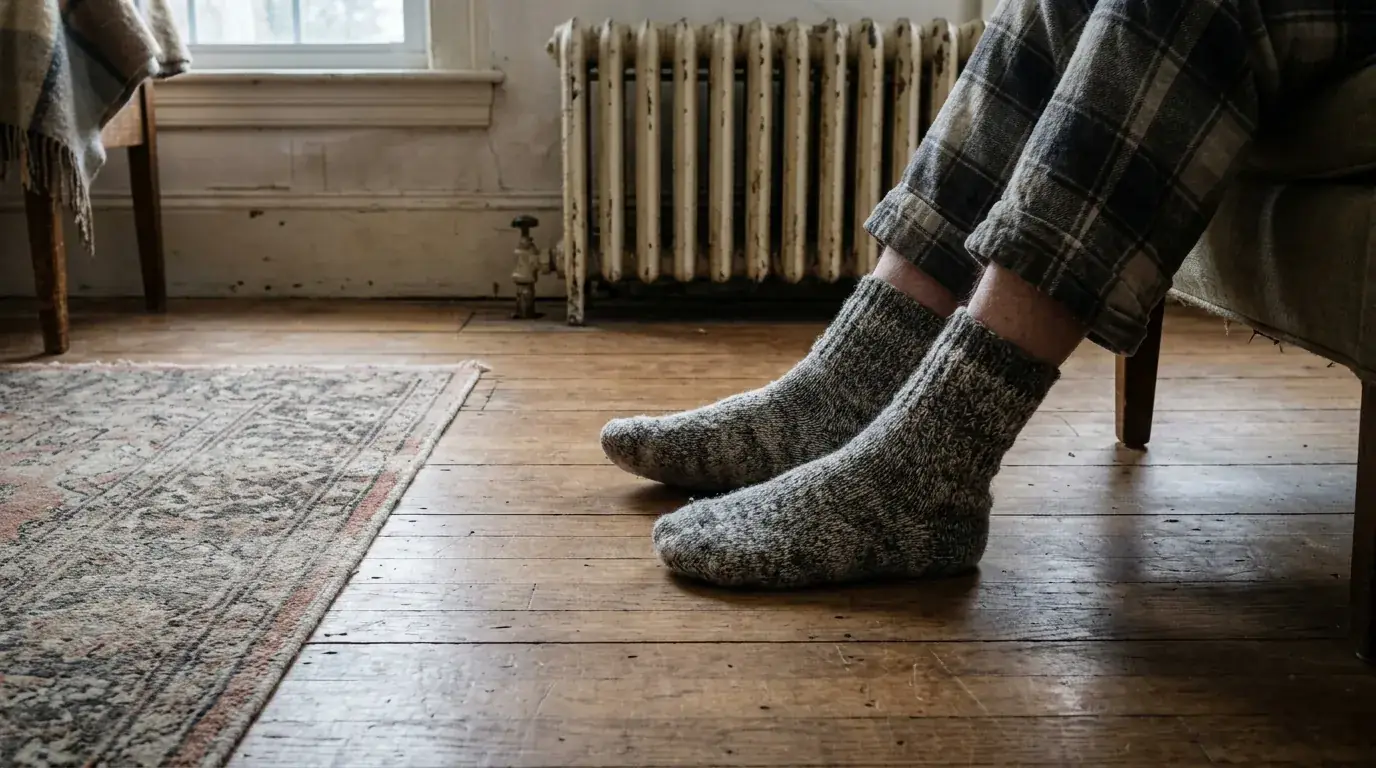
A floor feels cold when the air and surfaces below it are cold. In a typical Massachusetts home, three things cause it:
- Cold air leaking into the basement or crawl space, especially at the rim joists.
- Floors over unheated spaces such as garages, porches and crawl spaces with no insulation.
- The stack effect, which pulls outside air in at the bottom of the house as warm air escapes at the top. See why your house is drafty.
Start in the basement
Go downstairs on a cold, windy day and feel along the top of the foundation walls. You will often feel air moving at the rim joist, the band of wood where the floor framing sits on the foundation. In older homes it is uninsulated and has gaps at every joint, around pipes and wires and at the sill. Sealing and insulating it with closed-cell spray foam is one of the most effective cold-floor fixes. See our rim joist guide.
Should you insulate the basement ceiling?
Insulating between the floor joists of the basement ceiling separates the house from the basement, but it makes the basement colder, which can put pipes at risk and does little for air leaks at the rim. In most homes with a furnace, boiler or plumbing in the basement, it is better to bring the basement inside the thermal envelope: seal and insulate the rim joists and the foundation walls. See basement insulation.
Floors over garages and porches
Bonus rooms and family rooms over garages are notorious for cold floors. The fix is to fill the floor cavities completely, with dense-pack cellulose or spray foam from below, and to seal the ends of the joist bays. See cold room above the garage.
Crawl spaces
Additions and older homes often sit on vented crawl spaces that are open to winter air. Sealing and insulating the crawl space walls, with a ground vapor barrier, usually works better than insulating the floor above. See crawl space encapsulation.
| Below the floor | Best fix |
|---|---|
| Full basement | Seal and insulate rim joists and foundation walls |
| Garage | Dense-pack or spray foam the floor cavities; seal joist ends |
| Crawl space | Seal and insulate crawl walls, ground vapor barrier |
| Porch or cantilever | Insulate and air seal the overhang from below |
Many colonials have second floors or bay windows that hang over the foundation. The floor of that overhang is often barely insulated and very leaky. It is an easy fix with dense-pack or spray foam.
What about radiant floor heat or rugs?
Rugs and slippers help comfort, and radiant floor heating feels wonderful, but neither stops the heat loss. Fix the air leaks and insulation first; any heating system will then work better.
How to find the source of your cold floor
- On a cold day, go to the space below the floor (basement, crawl space or garage).
- Feel for moving air along the top of the foundation, around pipes and at basement windows.
- Look at the insulation between joists: is there any, has it fallen, are there gaps?
- Check the temperature of the space below; a thermometer helps.
- Look for overhangs and cantilevers above you, like bay windows and garrison overhangs.
Cold floors by home type
| Home type | Common cause |
|---|---|
| Older home on fieldstone | Leaky sill and rim joist, cold basement |
| Raised ranch or split-level | Rim joists at several levels, rooms over garage |
| Colonial with garrison overhang | Poorly insulated overhang floor |
| Addition on a crawl space | Vented crawl space open to winter air |
| Slab-on-grade room | Uninsulated slab edge |
Floor coverings and comfort
Hardwood and tile feel colder than carpet because they conduct heat away from your feet faster. A rug helps comfort, but it does not change the heat loss. Fixing the source makes every floor covering feel warmer.
Radiant heat and cold floors
Radiant floor heating feels wonderful, but installing it under a floor that loses heat to an unheated space wastes energy. Insulating and air sealing beneath the floor is the first step in any radiant project.
The order we recommend
- Seal and insulate rim joists.
- Address floors over garages, overhangs and crawl spaces.
- Seal the attic to reduce the stack effect.
- Insulate basement walls if the basement is used or holds mechanicals.
Most homeowners notice warmer floors immediately after the rim joist work, especially on windy days.
Warm floors this winter
BCI Group fixes cold floors by sealing and insulating basements, crawl spaces and floors over garages across Massachusetts. Call (774) 278-8256 or request a free estimate.
Frequently asked questions
Why are my floors cold even with the heat on?
Cold air is usually leaking into the basement or crawl space, or the floor sits over an unheated garage or porch without enough insulation.
Should I insulate my basement ceiling?
In most homes with mechanicals in the basement, sealing and insulating the rim joists and foundation walls works better than insulating the basement ceiling.
Does spray foam help cold floors?
Closed-cell spray foam at the rim joists seals one of the biggest sources of cold air, which often makes a noticeable difference.
Why is the floor over my garage cold?
The garage is unheated, and the floor insulation often has gaps and air leaks. Filling the cavities and sealing joist ends fixes it.
Will air sealing the attic help cold floors?
Yes. Less air escaping at the top of the house means less cold air pulled in at the bottom.
Services mentioned in this article
Spray Foam Insulation near you in Massachusetts
BCI Group crews work in these communities every week. See local details for spray foam in your town: