
Key takeaways
- Owners of one- to four-unit buildings can use the residential Mass Save® program, including for rental units.
- Owners of larger buildings use separate multi-family and commercial paths.
- Insulating the attic, walls and basement of a two- or three-family building reduces heating costs and tenant complaints.
- Tenants who pay their own heat benefit directly; owners benefit from lower turnover and a better building.
Why rental buildings are worth insulating
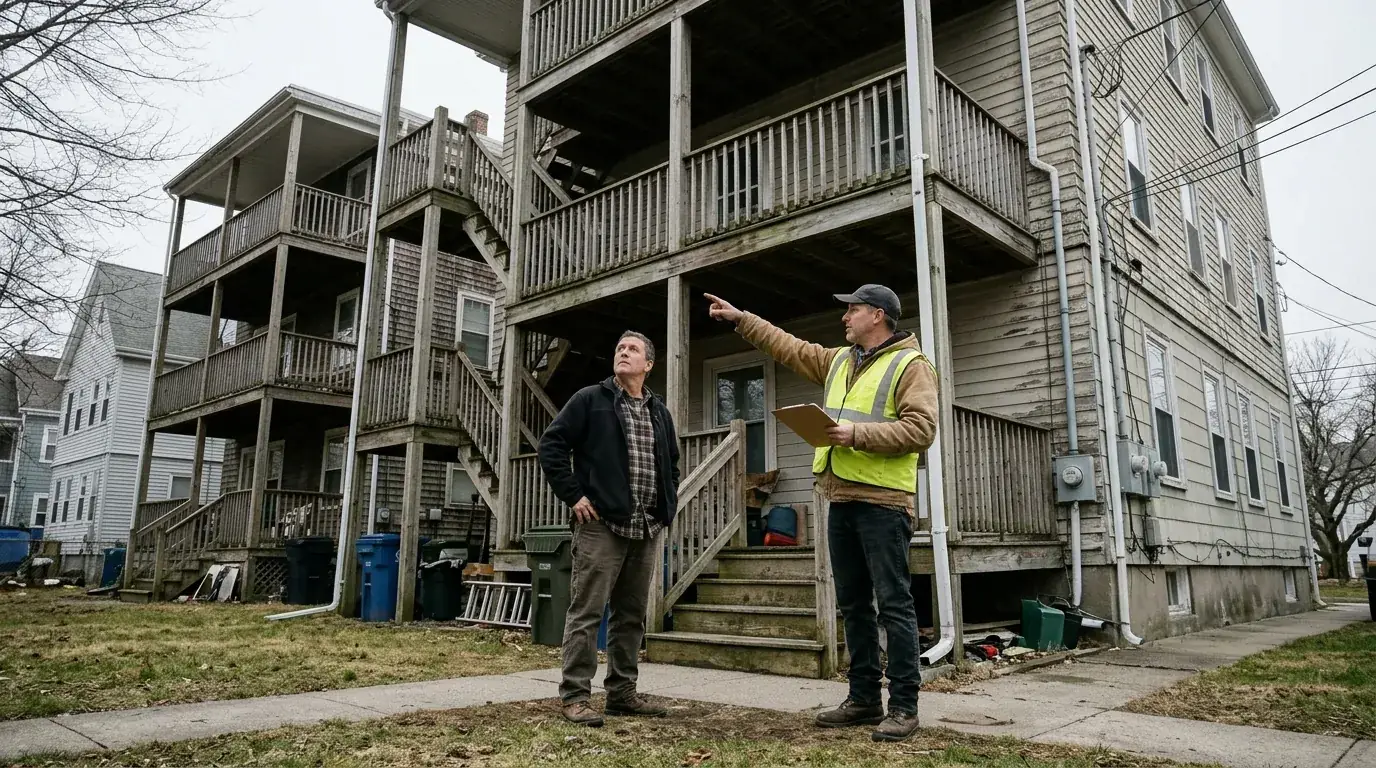
Massachusetts has some of the oldest rental housing in the country. Triple-deckers, two-families and side-by-side duplexes built between 1880 and 1930 make up a large share of the housing in Worcester, Somerville, Lowell, Fall River and many other cities. Most were built with no wall insulation at all, and the attic often has only a few inches of old material.
For owners, that means cold units, frozen pipes, heating complaints and, when tenants pay their own heat, tenants who move out after their first winter bill. Insulation and air sealing address all of it, and Mass Save® pays for a large share.
Which path applies to your building
| Building | Program path |
|---|---|
| 1 to 4 units | Residential Mass Save® (Home Energy Assessment) |
| 5 or more units | Multi-family program |
| Mixed use or commercial | Commercial and small business programs |
For one- to four-unit buildings, the owner can schedule an assessment for the building. Each unit with its own utility account may also be assessed. If tenants are income-eligible, enhanced help may be available; see income-eligible programs.
What we typically do on a triple-decker
- Attic: seal the top-floor ceiling bypasses (chimneys, plumbing stacks, wiring holes) and blow insulation to the recommended depth.
- Walls: dense-pack the empty exterior walls with blown-in cellulose, unit by unit, through holes hidden behind lifted siding.
- Basement: air seal and insulate the rim joists, where cold air enters under the first-floor unit.
- Between floors: where balloon framing lets air travel from the basement to the attic inside the walls, the wall cavities are blocked so heat does not escape through them.
Our full guide to insulating triple-deckers covers the details.
In balloon-framed buildings, open wall cavities can act like chimneys in a fire. Dense-packed cellulose and proper fireblocking slow that path down.
Working around tenants
Most of the work happens in the attic, the basement and from the outside of the building. When wall insulation is installed from the outside, tenants are barely affected. We schedule the work in advance, give notice for any interior access, protect floors and clean up each day.
What owners gain
- Fewer complaints and service calls about cold rooms and drafts.
- Lower heating bills for owner-paid heat, or a more attractive unit when tenants pay.
- Fewer frozen pipes in exterior walls and basements.
- A better building to refinance or sell.
A landlord's planning checklist
- List each unit's utility accounts: who pays heat and electricity.
- Gather access: keys or contacts for the attic, basement and each unit.
- Notify tenants early: explain what will happen and when.
- Check for barriers: knob-and-tube wiring, vermiculite, roof leaks.
- Plan the whole building: attic, walls, basement and common areas at once.
- Keep records: proposals, invoices and certificates for each area.
Who pays and who benefits
| Heat paid by | Owner benefit | Tenant benefit |
|---|---|---|
| Owner | Lower operating cost | More comfortable unit |
| Tenant | Easier to rent, fewer complaints, less turnover | Lower bills, more comfortable unit |
Either way, the building is in better shape: fewer frozen pipes, fewer ice dams and less wear on the heating system.
Common multi-family problem areas
- Top-floor units: cold in winter and hot in summer because of the attic above.
- First-floor units: cold floors from the basement and rim joists.
- Stairwells: connect the basement to the attic and leak heat and noise.
- Porches: ceilings and floors that connect into wall cavities.
- Shared basements: leaky rim joists, old heating plants and pipes at risk of freezing.
Code and safety considerations
Older multi-family buildings may need attention to fire separation and fireblocking during insulation work, especially in balloon-framed buildings. Coordinating fireblocking with insulation is efficient and improves safety.
Communicating with tenants
Tenants appreciate clear notice and a simple explanation: "We are insulating the building to make your apartment warmer and lower energy bills. Most of the work will be outside, in the attic and in the basement." A short notice with dates and contact information prevents most concerns.
Planning for heat pumps later
If you are considering heat pumps for the units in the future, insulating first reduces the size and cost of each system. It also makes it easier to separate heating costs by unit if you move from a shared boiler to individual systems.
How to start
Call BCI Group at (774) 278-8256. We will help you schedule the assessment, walk the building with you and explain what each unit qualifies for. We work in multi-family buildings across Worcester, Middlesex, Essex and Bristol counties.
Frequently asked questions
Can a landlord get Mass Save® rebates for rental units?
Yes. Owners of one- to four-unit buildings can use the residential program for their rental units.
Do tenants need to be home during the work?
Usually not for attic, basement or exterior wall work. Interior access, when needed, is scheduled with notice.
What about buildings with five or more units?
Larger buildings use Mass Save® multi-family or commercial paths, which have their own assessments and incentives.
Who pays if the tenants are income-eligible?
When tenants qualify, enhanced help may be available for the building. The details depend on the building and current program rules.
Will insulation help with frozen pipes?
Air sealing and insulating the basement rim joists and exterior walls reduces the cold air reaching pipes, which lowers the risk of freezing.
Services mentioned in this article
Mass Save® Upgrades near you in Massachusetts
BCI Group crews work in these communities every week. See local details for Mass Save® in your town: