
Key takeaways
- Stacked two-families lose heat through the attic, walls and basement like single-family homes, with extra paths at stairwells.
- Dense-pack walls, attic air sealing and rim joist foam are the core upgrades.
- Sealing and insulating between units improves comfort and reduces noise and odors.
- Two-families use the residential Mass Save® program; each unit can be assessed.
Two-families come in two shapes
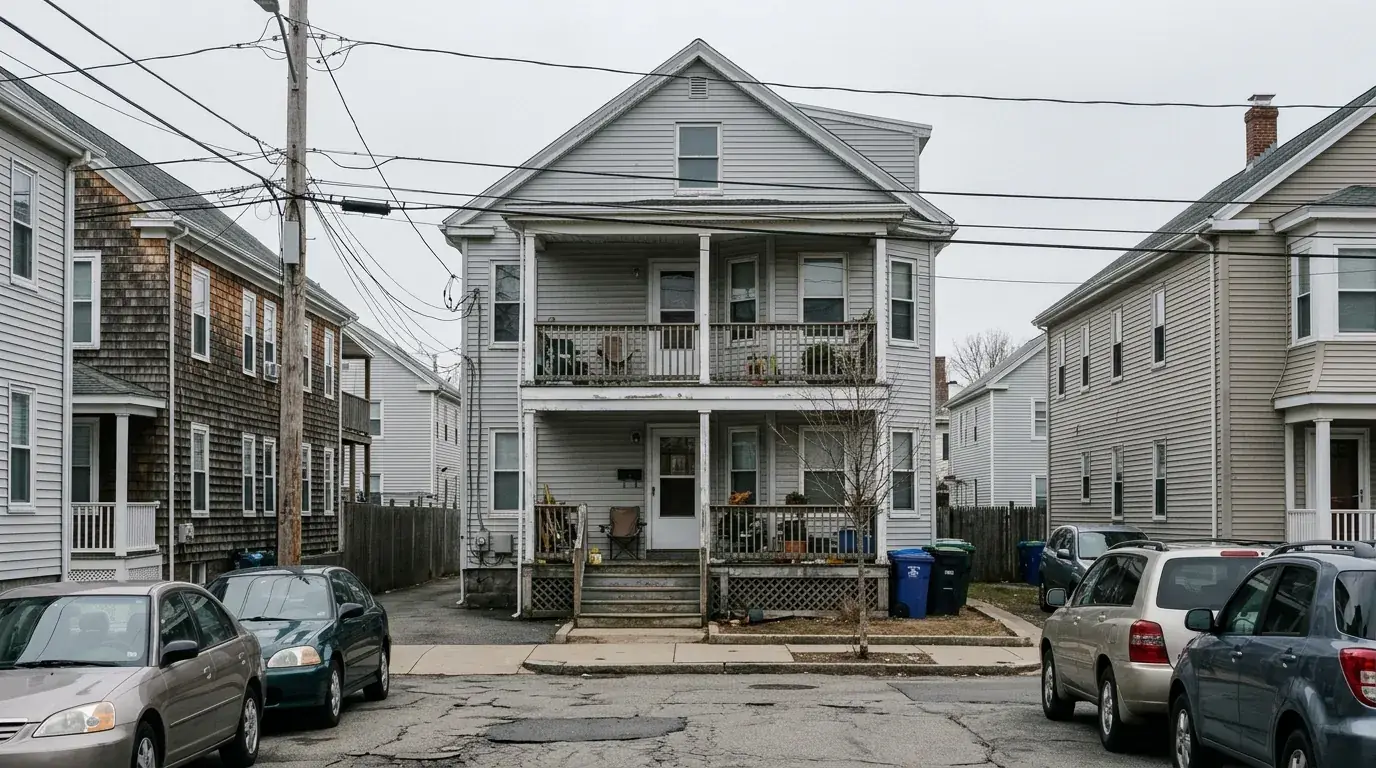
- Stacked ("double-decker"): one unit per floor, very common in Somerville, Cambridge, Waltham, Quincy, Lynn and Lowell.
- Side-by-side: two units sharing a party wall.
Most older two-families were built between the 1880s and 1930s with balloon framing and no wall insulation.
Where heat goes
- The attic above the top unit.
- Exterior walls, usually empty.
- The basement, often shared, with leaky rim joists.
- Common stairwells and hallways, which connect floors and leak to the attic.
- Porches, where ceilings and floors connect to wall cavities.
Core upgrades
| Area | Upgrade |
|---|---|
| Attic | Air seal, insulate to R-49+ |
| Exterior walls | Dense-pack cellulose from outside |
| Rim joists | Closed-cell spray foam |
| Common stairwell | Seal at the top and bottom; weatherstrip doors |
| Floor between units | Mineral wool or dense-pack for sound (during renovation) |
See dense-pack cellulose and rim joist insulation.
Sound and odors between units
Stacked units often share floor/ceiling assemblies with open joist bays. Sound, cooking odors and even smoke can travel between units. During renovations, filling these spaces with mineral wool and sealing penetrations helps. See soundproofing walls.
Owner-occupied two-families
Many two-families are owner-occupied with one rental unit. Upgrades benefit both: lower bills for each unit, fewer complaints and a more valuable building.
Mass Save® for two-families
Two-families use the residential Mass Save® program. Each unit with its own utility account can be assessed. See Mass Save® for landlords.
Insulating the walls of one unit only leaves the other leaking into it. Doing the whole building at once is more effective and often simpler to schedule.
Stacked vs. side-by-side: the differences
| Stacked two-family | Side-by-side duplex | |
|---|---|---|
| Attic | Above the top unit only | Shared, above both units |
| Basement | Usually shared | Shared or separate |
| Heat loss pattern | Top unit loses through roof; bottom through floor | Both units lose through roof and floor |
| Sound issues | Floor/ceiling between units | Party wall between units |
Unit-by-unit comfort
In stacked two-families, the top unit benefits most from attic work and the bottom unit from basement and rim work. Doing both ensures neither tenant is left with a cold apartment.
Common hallway and stair issues
Shared entries and stairwells often connect the basement and attic. Sealing at the attic and basement, weatherstripping unit doors and insulating stairwell exterior walls reduce drafts, odors and noise.
Separate heating systems
Many two-families have separate boilers or furnaces for each unit. After weatherization, both systems run less. Owners considering heat pumps can convert unit by unit.
Condo two-families
Many two-families have been converted to condos. Exterior walls, attics, roofs and basements are often common elements, so projects require both owners' agreement. Shared benefits make these projects easy to agree on.
Insulate your two-family
BCI Group insulates two-families across Greater Boston and Massachusetts. Call (774) 278-8256 or request a free estimate. See our Somerville and Cambridge pages.
Frequently asked questions
Can both units of a two-family be insulated at once?
Yes, and it is usually the most effective approach.
Does Mass Save® cover two-family homes?
Yes. One- to four-unit buildings use the residential program, and each unit can be assessed.
How do I reduce noise between units?
Filling floor and wall cavities with mineral wool and sealing penetrations helps, usually during renovation.
Should the basement of a two-family be insulated?
Sealing and insulating the rim joists warms the first-floor unit and reduces drafts throughout.
Will tenants be disturbed?
Most work is done from outside, in the attic and in the basement, with notice for any interior access.
Services mentioned in this article
Blown-In Cellulose near you in Massachusetts
BCI Group crews work in these communities every week. See local details for blown-in cellulose in your town: