Key takeaways
- HRVs and ERVs bring in fresh air and exhaust stale air at the same time, recovering heat from the outgoing air.
- An HRV transfers heat only; an ERV transfers heat and some moisture.
- In Massachusetts, both are used; ERVs help keep winter air from getting too dry and summer air from getting too humid.
- They are most common in new construction and deep retrofits with very tight envelopes.
Why tight homes need ventilation
Air sealing and spray foam make homes comfortable and efficient, but they also remove the random air leaks that used to provide fresh air. Fresh air is still needed to remove moisture, odors, carbon dioxide and pollutants. The answer is mechanical ventilation designed for the house. See why a tight house needs ventilation.
Three ways to ventilate
| Strategy | How it works | Notes |
|---|---|---|
| Exhaust-only | Quiet bath fan runs continuously; air enters through small leaks | Simple, common in existing homes |
| Supply-only | Fresh air is brought in, often through the HVAC | Less common in cold climates |
| Balanced (HRV/ERV) | Equal air in and out through a heat exchanger | Best control; recovers heat |
How an HRV or ERV works
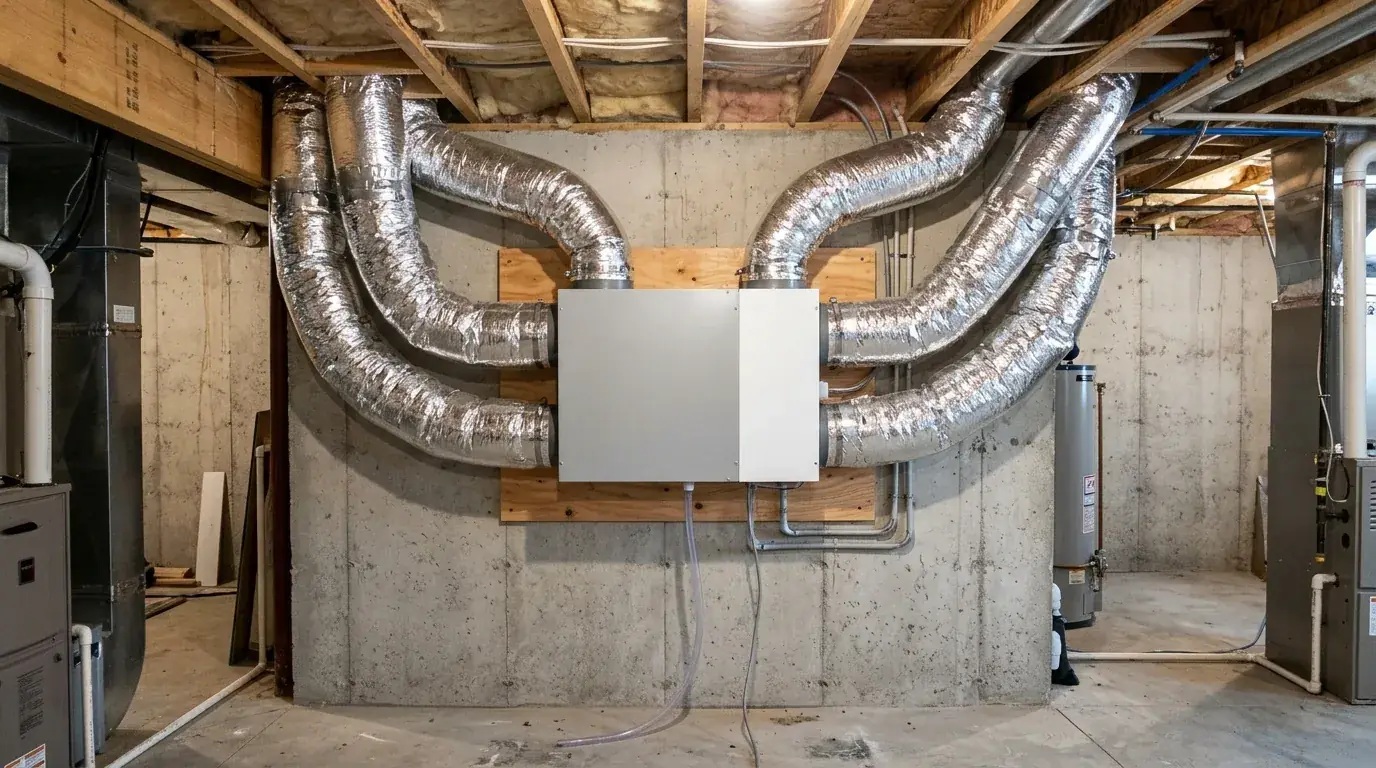
A balanced ventilator has two fans and a heat exchanger core. Stale air from bathrooms and kitchens passes through the core on its way out; fresh outdoor air passes through on its way in. The two streams do not mix, but heat transfers from the warm stream to the cold one. In winter, incoming fresh air is pre-warmed by the outgoing air.
HRV vs. ERV
| HRV (heat recovery) | ERV (energy recovery) | |
|---|---|---|
| Transfers | Heat | Heat and some moisture |
| Winter effect | Can dry the house more | Retains some indoor humidity |
| Summer effect | Brings in outdoor humidity | Reduces incoming humidity somewhat |
| Common use | Homes with higher indoor humidity | Many Massachusetts homes, especially very tight ones |
Both work in Massachusetts. The choice depends on the home's humidity, occupancy and the designer's recommendation.
When you need one
- New construction built tight to meet the Stretch Code, especially with low ACH50 results.
- Deep energy retrofits with spray foam envelopes.
- Homes with indoor air quality concerns.
Most existing homes after standard air sealing are well served by a continuous bath fan.
An HRV or ERV should be designed with dedicated ducts or carefully integrated with the HVAC, and balanced at startup so supply and exhaust match.
Typical ERV/HRV layouts
| Layout | How it works |
|---|---|
| Fully ducted | Dedicated ducts supply fresh air to bedrooms and living areas, exhaust from baths and kitchen |
| Simplified | Supply air into the HVAC return or main living areas; exhaust from bathrooms |
| Point-source units | Small through-wall units in individual rooms |
Fully ducted systems give the best distribution, especially to bedrooms.
Maintenance
- Clean or replace filters regularly.
- Clean the core according to the manufacturer.
- Keep outdoor intake and exhaust hoods clear of snow, leaves and debris.
- Check that controls run the unit at the designed speed.
Balancing and commissioning
At installation, airflows should be measured and balanced so supply and exhaust match the design. An unbalanced system can pressurize or depressurize the house, reducing efficiency and comfort.
Winter frost protection
In very cold weather, some HRVs and ERVs need defrost strategies to prevent ice on the core. Most units include automatic defrost. Proper installation in a conditioned space helps.
Is it worth it?
In very tight homes, balanced ventilation with heat recovery provides fresh air while saving much of the heat in the exhaust air. Occupants often notice fresher air, fewer odors and better humidity control. In older homes after standard air sealing, a quiet continuous bath fan is usually the more practical solution.
Get ventilation right
BCI Group's HERS raters calculate ventilation needs and test homes, and our crews build the tight envelopes that make balanced ventilation worthwhile. Call (774) 278-8256 or see energy audits and HERS ratings.
Frequently asked questions
What is the difference between an ERV and an HRV?
Both recover heat from exhaust air; an ERV also transfers some moisture, an HRV does not.
Which is better in Massachusetts?
Both are used. ERVs are popular in very tight homes because they help keep winter air from getting too dry.
Do I need an ERV or HRV in an older house?
Usually not after standard air sealing. A continuous bath fan often provides enough ventilation.
Do HRVs and ERVs use a lot of energy?
They use modest fan energy and recover much of the heat in the exhaust air.
Can an ERV replace bath fans?
An ERV can exhaust from bathrooms in some designs, but many homes still use local fans for showers and cooking.
Services mentioned in this article
Energy Audits & HERS Ratings near you in Massachusetts
BCI Group crews work in these communities every week. See local details for energy audits in your town: