Key takeaways
- Most insulation slows heat conduction but lets air pass through it.
- Air leaking into the attic carries heat and moisture, causing high bills, ice dams and mold.
- Sealing chimneys, plumbing stacks, wiring holes, top plates, lights and the hatch comes first.
- Once the attic is buried in insulation, those leaks are hard to reach, so sealing must happen first.
Insulation and air sealing do different jobs
Fiberglass and loose cellulose insulation slow the flow of heat by trapping air in tiny pockets. But they are not air barriers: air can move through them. If there is a gap in the attic floor, warm air from the house flows up through the gap and right through the insulation above it. That is why an attic can have a foot of insulation and still have ice dams and high bills.
Air sealing closes the gaps. Then the insulation can do its job.
Where the leaks are
- Chimney chases: often a large gap around the chimney, open to the floors below.
- Plumbing vent stacks and drain pipes.
- Electrical wire holes in the top plates of walls.
- Top plates of interior walls, especially in older homes where the drywall or plaster does not seal to them.
- Recessed lights, older ones especially.
- Bath fans and their ducts.
- Dropped soffits over kitchen cabinets and bathtubs, which can be open to the attic.
- Balloon-framed walls open at the top.
- The attic hatch or pull-down stairs.
How each leak is sealed
| Leak | Typical material |
|---|---|
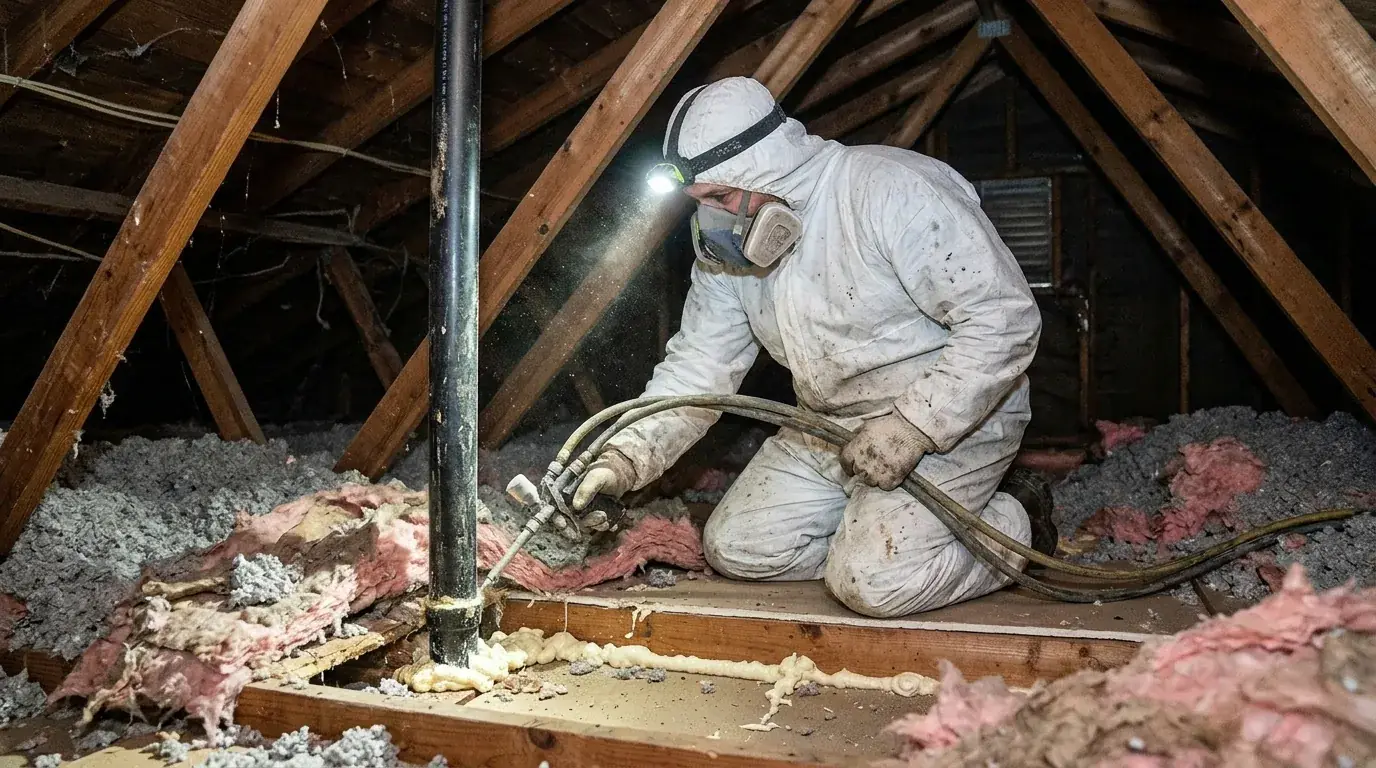
| Small holes (wires, pipes) | Spray foam or fire-rated caulk |
| Large openings (dropped soffits, open walls) | Rigid foam or drywall, sealed at the edges |
| Chimney chase | Sheet metal with fire-rated sealant (no foam against the chimney) |
| Recessed lights | Airtight covers or IC-rated airtight fixtures |
| Attic hatch | Weatherstripping, latches and an insulated cover |
The attic hatch
A plain attic hatch is often a loose board with no weatherstripping and a few inches of insulation. Adding weatherstripping, a latch that pulls it tight and a rigid foam cover on top turns it from a big leak into a solid part of the ceiling. Pull-down stairs can be covered with an insulated, airtight box.
Materials around chimneys and flues must be non-combustible. A trained crew knows the required clearances.
Why it must happen first
Once a new layer of insulation is blown in, the leaks are buried and very hard to reach. That is why reputable contractors and the Mass Save® program air seal before insulating. If an attic already has deep insulation but still has problems, the crew may need to pull it back in key areas to seal underneath.
What air sealing achieves
- Lower heating and cooling bills.
- Fewer ice dams and icicles.
- Less moisture reaching the roof deck, so less risk of attic mold.
- Fewer drafts throughout the house, thanks to a weaker stack effect.
Measuring the result
A blower door test before and after shows how much leakage was removed. It is the best proof the job was done well.
Air sealing materials, explained
| Material | Used for | Notes |
|---|---|---|
| One-part canned foam | Small gaps around wires and pipes | Not for use against chimneys or flues |
| Two-part spray foam | Larger areas, top plates, rim joists | Professional application |
| Fire-rated caulk or foam | Penetrations requiring fire resistance | Follow product listings |
| Rigid foam board | Covering large openings like dropped soffits | Edges sealed with foam or caulk |
| Sheet metal + high-temp sealant | Around chimneys and flues | Non-combustible |
| Weatherstripping | Attic hatches and doors | Compressible gasket for a tight seal |
Dropped soffits and chases: the hidden big leaks
Kitchens often have a soffit above the cabinets that is open to the attic. Bathrooms may have dropped ceilings over tubs. Plumbing and duct chases may run from the basement to the attic. From the attic, these look like large open holes in the ceiling plane. Covering them with rigid foam or drywall and sealing the edges stops large amounts of air flow.
Recessed lights
Older recessed lights are often not airtight and may not be rated for insulation contact. Options include airtight covers built to the manufacturer's clearance requirements, replacing fixtures with airtight IC-rated models or switching to surface-mounted LED fixtures. Never bury non-IC-rated fixtures in insulation.
Balloon-framed walls
In older homes, wall cavities may be open to the attic at the top. Stuffing them with rolled insulation does not stop air. Better approaches are blocking the tops with rigid material and sealing, or dense-packing the cavity from the attic, which also slows air flow.
How long air sealing takes
In a typical attic, air sealing can take several hours, longer in complex attics with many penetrations, balloon framing or limited headroom. It is careful, detailed work, and it is the part of the job that makes the biggest difference.
Get your attic sealed
BCI Group's crews air seal every attic before insulating. Eligible Mass Save® customers can receive air sealing at no cost. Call (774) 278-8256 or request a free estimate.
Frequently asked questions
Does insulation stop air leaks?
Most loose and batt insulation does not stop air. Air sealing closes the gaps; insulation then slows heat conduction. Spray foam is an exception because it does both.
What is the most important leak to seal in an attic?
It varies, but large openings like chimney chases, dropped soffits and open wall tops are often the biggest.
How do you insulate an attic hatch?
Weatherstrip the opening, add a latch to pull it tight and attach rigid foam insulation to the top of the hatch.
Is air sealing included in Mass Save®?
Yes. Eligible customers can receive targeted air sealing at no cost after a Home Energy Assessment.
Can too much air sealing be a problem?
Older homes are rarely made too tight. Ventilation and combustion safety are checked, and mechanical ventilation is added if needed.
Services mentioned in this article
Insulation Contractor near you in Massachusetts
BCI Group crews work in these communities every week. See local details for insulation in your town: